Collaborative Seminar on Artificial Intelligence
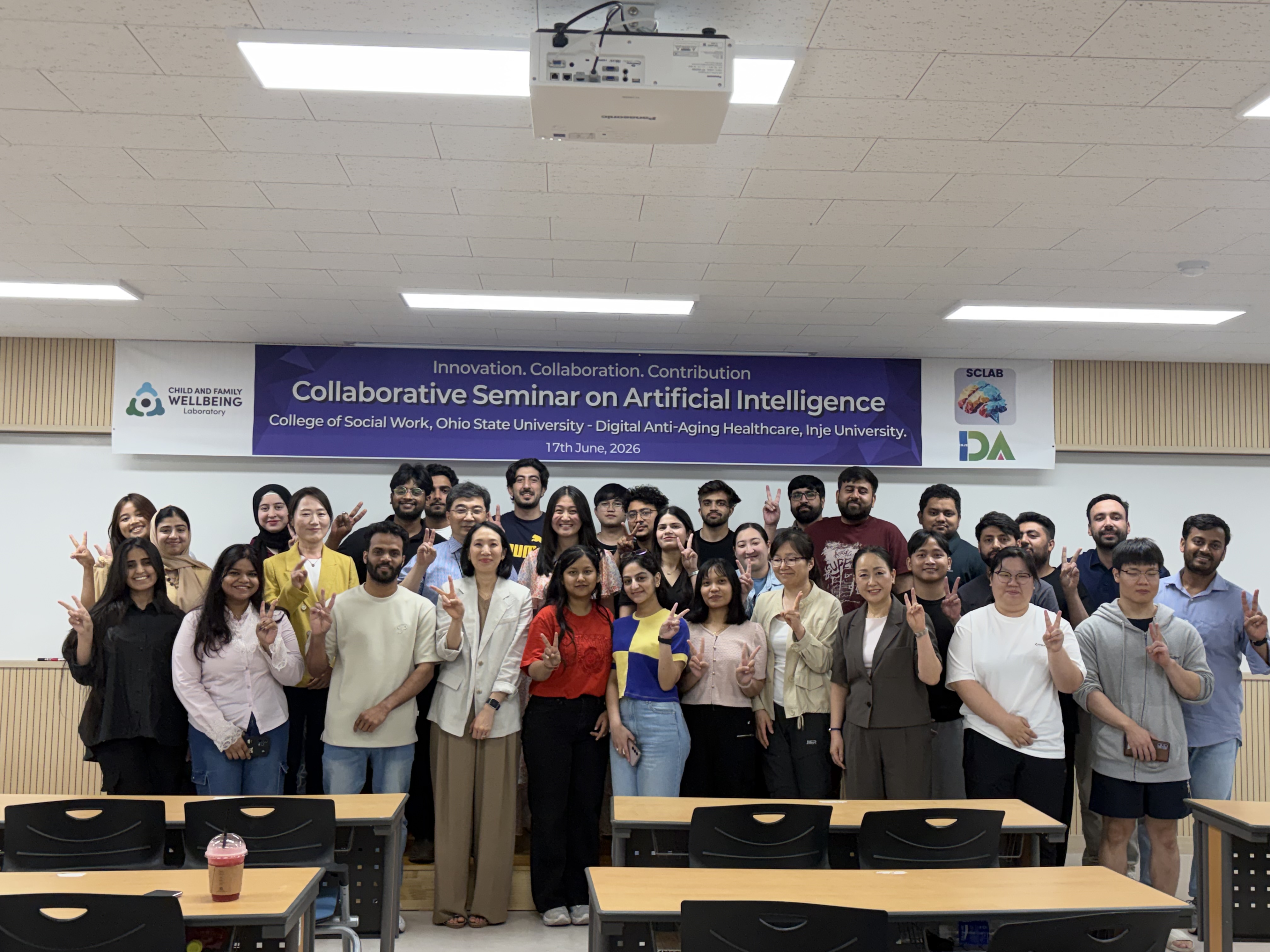
17 June 2026 | College of Social Work, The Ohio State University – Digital Anti-Aging Healthcare, Inje University
Hosts: SCLab (Smart Computing Laboratory), IDA (Digital Anti-Aging Healthcare), Inje University
The Collaborative Seminar on Artificial Intelligence brought together researchers from Inje University and The Ohio State University to foster academic exchange, interdisciplinary collaboration, and innovation in AI-driven healthcare and social sciences. The seminar commenced with an introduction to the Smart Computing Laboratory (SCLab) by Professor Hee Cheol Kim and Dr. Md. Ariful Islam Mozumder, who presented the laboratory’s vision, ongoing research activities, and recent achievements in artificial intelligence, medical image analysis, and healthcare informatics. They highlighted SCLab’s efforts in developing advanced AI technologies for disease diagnosis, prognosis prediction, digital pathology, and intelligent healthcare systems.
Professor Hee Cheol Kim further delivered a presentation on “Cancer Analysis with Artificial Intelligence,” showcasing how modern AI and deep learning techniques are transforming cancer research. His talk emphasized the application of machine learning, computer vision, and foundation models in cancer diagnosis, prognosis prediction, and precision medicine. The presentation demonstrated how AI-driven approaches can assist clinicians in analyzing complex medical data and improving decision-making in oncology.
The seminar also featured a distinguished presentation by Joyce Lee, Director of the Child and Family Wellbeing Laboratory at The Ohio State University College of Social Work. Professor Lee introduced her laboratory and provided an overview of its research mission focused on improving child and family wellbeing through data-driven approaches and interdisciplinary collaboration.
Professor Lee presented her recent study entitled “Most Important Predictors of Father–Child Contact in the U.S. Child Welfare System: A Machine Learning Approach.” Her presentation demonstrated how machine learning techniques can be utilized to identify key factors influencing father-child contact within the child welfare system. The research highlighted the potential of AI to uncover complex patterns in large-scale social welfare datasets, providing valuable insights that can support evidence-based policy development and interventions aimed at strengthening family relationships and improving outcomes for children and families.
The seminar concluded with an engaging discussion session, during which participants exchanged ideas on future collaborative research opportunities at the intersection of artificial intelligence, healthcare, and social welfare. The event successfully strengthened academic ties between Inje University and The Ohio State University and opened new avenues for interdisciplinary research collaboration.